Accurate Print-Time Prediction for Metal AM
How a more accurate build-time estimate helps you plan machine capacity, schedule production, and quote with confidence in Metal Additive Manufacturing
Why print time is hard to predict on an SLM machine
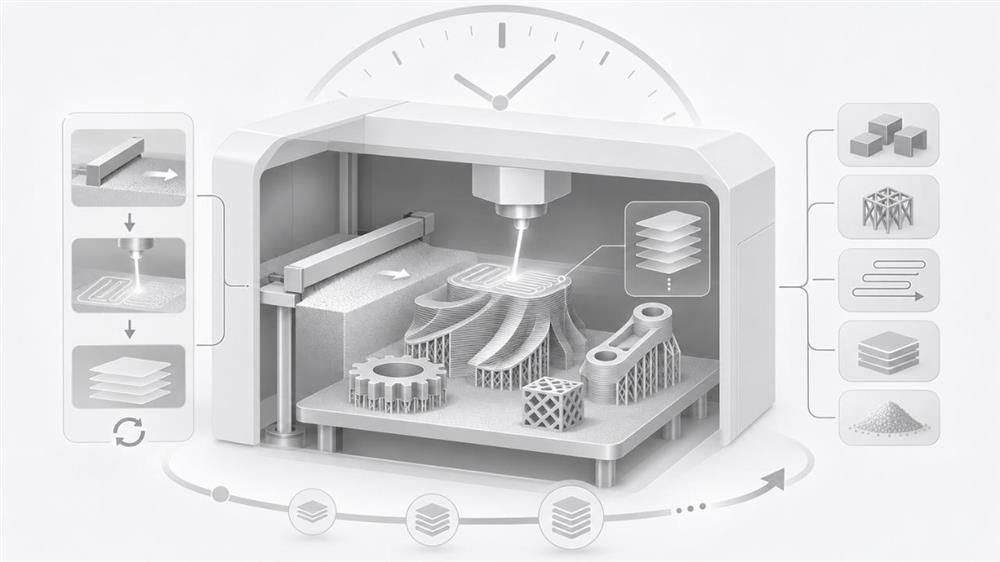
An SLM machine builds a part one layer at a time. A recoater spreads a layer of powder, the laser melts the cross-section of the part, the platform drops, and the cycle repeats until the build is finished.
How long that takes depends on several factors at once: part height and layer count, the area the laser scans on each layer, the scan strategy, recoating time, support structures and the number of parts on the build plate. Standard estimates simplify some of these, and the result can differ significantly from the real build time. Usually you only find out once the job is already running.
What an inaccurate estimate costs
For a service bureau or a production team, the gap between estimated and actual build time has a direct cost:
-
Idle machines, when a build finishes earlier than planned and the next job is not ready.
-
Rushed schedules, when a build runs longer and pushes back every job behind it, including heat treatment, machining and finishing.
-
Missed delivery dates, because the lead time given to the customer was based on the wrong number.
-
Quotes that miss, because price is based on machine time. Underestimate it and you lose margin. Overestimate it and you lose the bid.
What changed
ZRapid has developed a new print-time estimation algorithm that accounts for the real factors behind build duration. The estimate closely matches the actual printing time, and it is available before the job starts.
What it means in practice
Capacity planning. See how long each build will occupy a machine and plan utilisation across your fleet.
Reliable scheduling. Sequence jobs, plan operator shifts and book post-processing around realistic build times.
Predictable delivery. Give customers lead times you can keep.
Accurate quoting. Price jobs on real machine time, not rough approximations.
Better investment decisions. If you are deciding whether to bring metal printing in-house, machine hours per part are a core input to that calculation. A reliable estimate makes the business case more accurate.
Where it matters most
Service bureaus run many customer projects in parallel, each with different geometry, material and deadline. In that setting, as our HLH Prototypes case shows, the limit is rarely the machine itself. It is queue stability and how well work is spread across machines. Knowing build times in advance is what makes that planning possible.
The same applies to in-house production teams, where a metal part often moves on to heat treatment, CNC finishing or assembly. When the build time is known, the steps after it can be planned too.
Questions worth asking during evaluation
-
How close are the estimates to actual build time, and on which jobs and materials was that measured?
-
Which factors does the estimate account for? Layer count, scan area, scan strategy, recoating, supports and number of parts all affect build time.
-
Is the estimate available during build preparation, before the job is sent to the machine?
-
Can the estimate be used directly for quoting and production planning?
Conclusion
A reliable print-time estimate turns build preparation into a planning tool. You know how long each build will occupy a machine before it starts, so capacity, shifts, post-processing and customer lead times can be based on real numbers. The build itself takes as long as it takes. What changes is that you know it in advance.
Recommended next steps:
-
Ask for the estimation accuracy data and the test conditions behind it.
-
Request a demo using a part that is typical of your production.
-
Talk to ANiMA about machine capacity for your expected job mix.
Related advantages: Permanent Filtration System · Build Volume Reducer · Fully Open Parameters · Wide Material Support · Fast Material Changeover