Case Study - Handsaeme Machinery (Belgium)
Producing Load-Bearing Gate Wheels with Metal Additive Manufacturing
Introduction
In heavy industrial systems, components that combine motion and load transfer are often subject to strict mechanical requirements. Wheels guiding large gates are a typical example. They must support high static loads while maintaining smooth movement over a fixed track, often under varying load conditions. Reliability is essential, as failure or deformation directly affects the operation of the entire system.
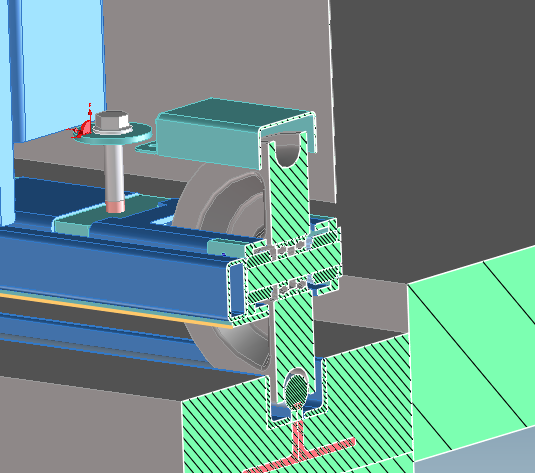
For this project, a set of four wheels was developed to support and guide a gate with a total weight of 4 tons. These wheels are responsible not only for carrying the load but also for ensuring stable and controlled movement along a track embedded in concrete. Instead of relying on conventional machining methods, the decision was made to produce the wheels using metal additive manufacturing on the iSLM 280 metal 3D printer.
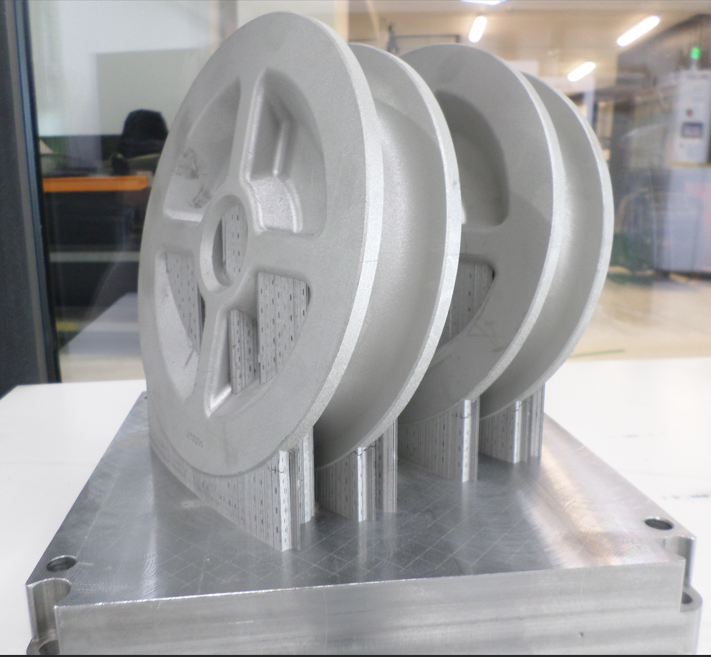
This case provides insight into how selective laser melting can be applied to load-bearing components where strength, geometry, and production efficiency need to be balanced. It also highlights how relatively small design changes, enabled by additive manufacturing, can influence the structural behaviour of a part.
Load Conditions and Functional Requirements
The total weight of the gate is 4 tons, distributed across four wheels. In practice, this load is not evenly shared at all times. Under static conditions, each wheel may carry up to 2 tons, depending on positioning and alignment. During movement, the load distribution changes continuously as the gate rolls along the track. This introduces dynamic variations that the wheels must accommodate without deformation or loss of alignment.
Because the system runs on a track fixed in concrete, the interface between the wheel and the track plays a critical role. The wheels must maintain consistent contact and resist localized stress concentrations. Any deviation in geometry or stiffness can result in uneven rolling behaviour, increased wear, or additional stress on the supporting structure. This makes dimensional stability and structural integrity key requirements for the design.
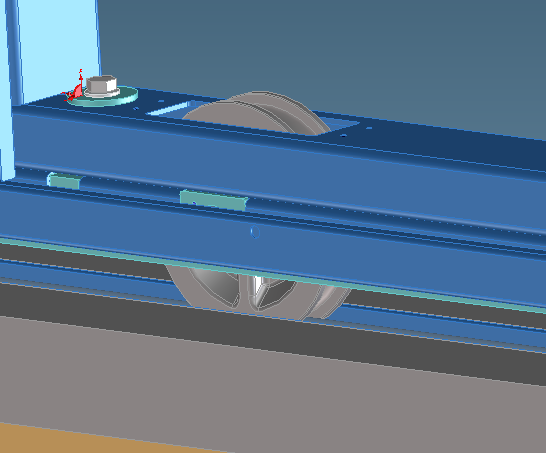
Material selection was also an important factor. The wheels are produced in stainless steel to ensure sufficient strength and resistance to environmental conditions. In applications like this, the combination of high load and repeated motion requires a balance between hardness, toughness, and long-term wear resistance. The design, therefore, had to ensure that the material is used efficiently while maintaining the required mechanical performance.
Limitations of the Previous Manufacturing Approach
Before adopting additive manufacturing, the wheels were produced as stainless-steel turned components. While machining provides high precision, it also comes with limitations when dealing with larger volumes of material and more complex geometries. In this case, the production of each wheel required a significant amount of machining time, given its size and material.
The subtractive nature of machining means that material is removed from a solid block, which results in longer production times and material waste. For relatively simple geometries, this approach remains effective. However, when additional structural features or reinforcements are needed, machining becomes less efficient. Any design change also requires adjustments to the machining process, which can further increase lead time.
Another limitation is the lack of flexibility in adding structural features that improve performance without unnecessarily increasing weight. In traditional turned parts, reinforcement typically means increasing overall thickness or mass. This can lead to over-dimensioned components that meet strength requirements but are not optimised in terms of material usage or internal stress distribution. For this application, a more flexible design approach was needed to improve efficiency without compromising strength.
Additive Manufacturing Approach and Design Adaptation
By transitioning to metal additive manufacturing, the wheels could be redesigned with a focus on structural efficiency rather than manufacturing constraints. Using the iSLM 280 metal 3D printer, the parts were built layer by layer, allowing greater freedom in how material is distributed throughout the component.
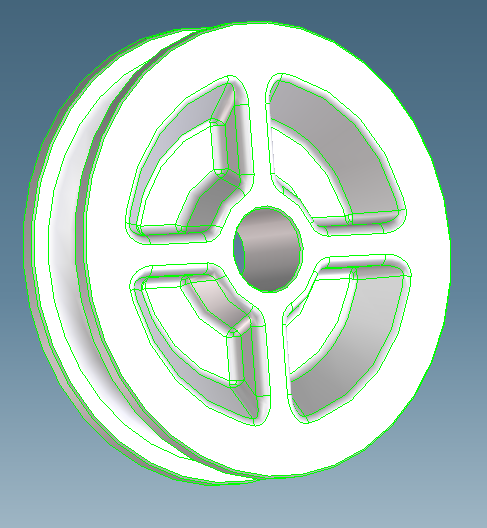
One of the key design improvements was the integration of reinforcing ribs within the wheel structure. These ribs increase stiffness and help distribute the load more effectively without significantly increasing the overall weight. Such features are difficult or inefficient to produce using traditional machining, but can be incorporated directly into an SLM design without additional manufacturing steps.
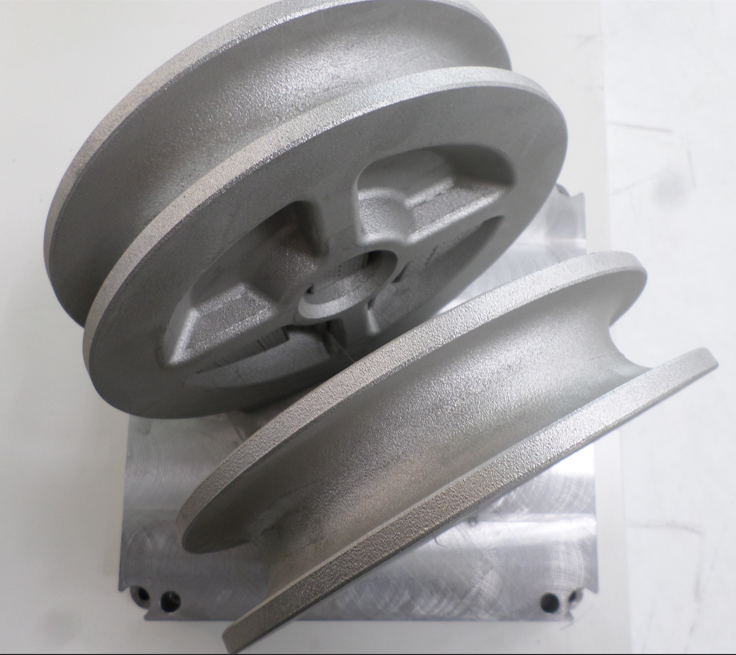
The production process also becomes more streamlined. Instead of multiple machining operations, the wheels are produced in a single build process, followed by necessary post-processing steps such as support removal and finishing of critical surfaces. This reduces manual labour and shortens production time, especially when multiple units are required. Although the wheels have not yet been installed and tested in operation, the initial results indicate that the design meets expectations in terms of geometry and structural integrity.
Conclusion
This project demonstrates how metal additive manufacturing can be applied to functional, load-bearing components in an industrial context. By moving away from conventional machining and adopting SLM, it becomes possible to introduce design features that improve structural behaviour while reducing production complexity.
The use of reinforced geometries within the wheel structure illustrates how additive manufacturing enables a different approach to engineering design. Instead of compensating for limitations in the manufacturing process, the design can be adapted to meet performance requirements more directly.
While final validation will take place once the wheels are installed and operating under real conditions, this case already shows how additive manufacturing can provide a practical alternative for components where load, motion, and durability are closely linked.
Metal 3D Printer Offer from ZRapid Europe
iSLM280 Now Under €150K
Contact us for the offer!
See the offer HERE
Email: info@anima.eu
Contact number: +30 210 77 76 822