Production-Grade SLM in Practice: How HLH Prototypes Expands Metal AM Capacity with ZRapid Systems
Introduction: Scaling Metal AM in Service Bureau Reality
Metal additive manufacturing has moved beyond its early role as a prototyping tool. In service bureau environments, it is now part of a broader production system that must handle repeatability, delivery reliability, and cost-controlled throughput across many parallel jobs. This shift changes what “good performance” means. Machine capability is no longer the only constraint; queue stability, workflow structure, and utilisation balance become equally important.
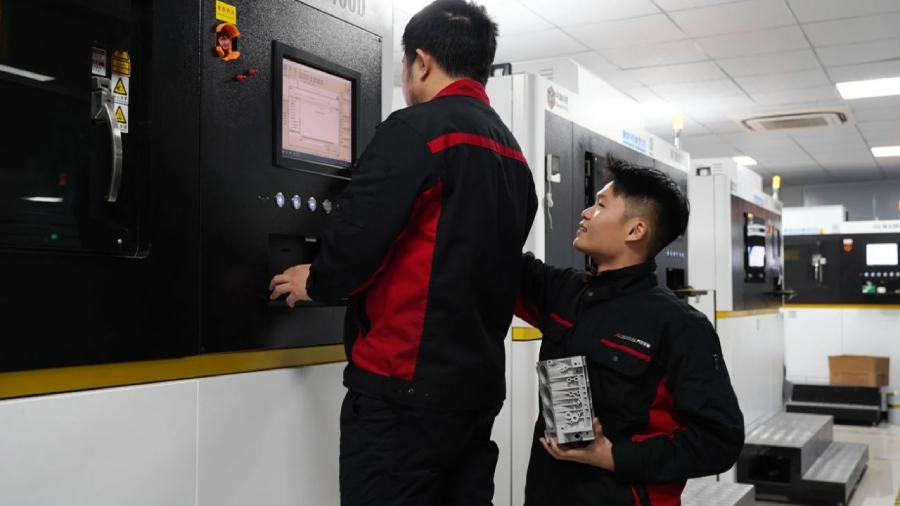
HLH Prototypes operates in this environment as a multi-technology manufacturing service bureau. Alongside CNC machining, SLA, SLS, vacuum casting, and injection moulding, metal AM plays a defined role in its production portfolio. Within this structure, SLM systems are used for functional prototypes, bridge production parts, and low-volume end-use components where geometry or material requirements cannot be met through subtractive or tooling-based processes.
The addition of multiple ZRapid SLM and SLA systems fits into this context as a capacity expansion decision. Rather than changing HLH’s production model, it strengthens the existing metal AM layer to handle increasing demand and maintain predictable turnaround times.
HLH Prototypes: Service Bureau Operating Model
HLH’s manufacturing model is based on high-mix production. This typically involves a large number of concurrent customer projects, each with different technical requirements, timelines, and post-processing needs. In this type of environment, production is not driven by a single process optimisation strategy, but by routing decisions across multiple technologies.
Incoming jobs are assessed and assigned based on geometry, material requirements, and delivery constraints. Some parts are better suited for CNC machining due to tolerance requirements. Others require SLA or SLS depending on surface quality or mechanical behaviour. Metal AM is used when design complexity, internal structures, or rapid iteration cycles make conventional manufacturing less suitable.
Within this structure, SLM functions as a flexible production resource rather than a standalone capability. It supports both engineering validation work and production-grade parts. The key requirement is not isolated print performance, but consistency across repeated builds and compatibility with downstream finishing processes.
This means that metal AM output must align with machining tolerances, assembly requirements, and finishing workflows. Without this alignment, the efficiency gains of additive manufacturing are often lost in post-processing or rework stages.
Why HLH Expanded SLM Capacity with ZRapid Systems
In service bureau environments, capacity constraints are rarely caused by lack of technology. They are more often the result of queue congestion, machine utilisation imbalance, and unpredictable job arrival patterns. Metal AM, in particular, tends to experience fluctuating demand due to its use in both urgent prototyping and small batch production.
As job volumes increase, the limitation becomes the ability to run multiple builds in parallel while maintaining stable scheduling. A single-machine setup creates dependency bottlenecks, where a delay in one job affects multiple downstream deliveries. Expanding machine count reduces this dependency and improves scheduling flexibility.
The decision to integrate multiple ZRapid SLM systems is aligned with this type of operational requirement. The focus is on increasing parallel processing capacity and improving workload distribution across the metal AM cell. In practice, this allows HLH to allocate jobs based on urgency, geometry, and build efficiency rather than machine availability alone.
The use of five systems also introduces redundancy into the production environment. Maintenance cycles, material changes, or unexpected downtime on one system do not interrupt overall output. This type of resilience is particularly relevant in service bureaus, where delivery reliability is part of the core service offering.
Production-Grade SLM in Daily Operations
In HLH’s workflow, metal AM jobs are typically grouped into three categories: engineering prototypes, functional testing parts, and low-volume production components. Each category has different expectations in terms of dimensional accuracy, surface finish, and mechanical performance.
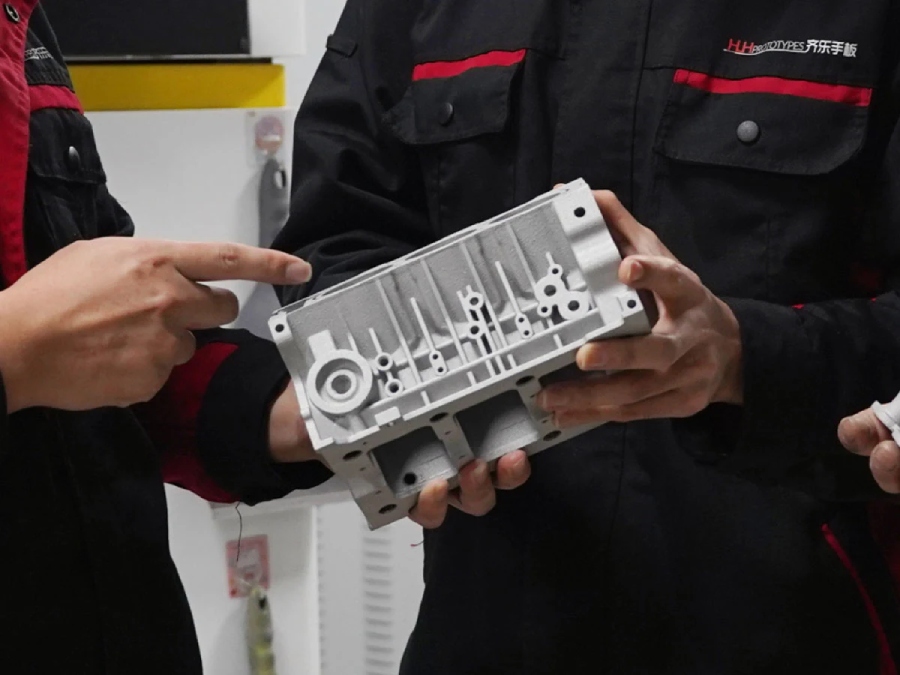
Engineering prototypes are usually part of iterative design cycles. The priority here is turnaround time and design validation rather than final surface quality. Functional testing parts require more stable mechanical properties, as they are used in real-world load or fit testing. Low-volume production parts require repeatability across batches, where dimensional consistency becomes critical.
Job allocation across the SLM fleet is based on a combination of geometry, build height, material scheduling, and delivery urgency. This reduces the need for sequential scheduling and allows multiple builds to run simultaneously under different configurations. The effect is not simply faster production, but a more stable distribution of workload across the manufacturing floor.
Continuous operation introduces its own requirements. Powder handling procedures, parameter consistency, and build preparation workflows must remain stable across machines and operators. In this type of environment, small variations in setup can accumulate into downstream variability, especially when parts move into machining or assembly stages.
The result is a production model where SLM functions as a repeatable industrial process rather than an isolated manufacturing step. The focus shifts from individual build optimisation to system-level consistency.
Integration into HLH’s Multi-Technology Manufacturing Chain
Metal additive manufacturing at HLH does not operate independently. Most parts produced through SLM continue through additional manufacturing stages. These may include heat treatment, CNC finishing, surface polishing, or assembly into larger systems.
This creates a dependency between SLM output and downstream processes. If tolerances or surface conditions vary significantly between builds, it affects machining time, fixture design, and overall lead time. For this reason, consistency across metal AM production is more important than marginal improvements in individual build performance.
The integration of multiple SLM systems supports this requirement by stabilising output volumes. Rather than scaling a single machine to its limits, workload is distributed across several systems operating under controlled and repeatable conditions. This reduces variability between builds and improves predictability in downstream operations.
In practice, this improves overall production flow. CNC and finishing operations receive more consistent input, which reduces adjustment time and rework. It also allows HLH to plan capacity across the entire manufacturing chain more effectively, rather than treating each technology in isolation.
Role of ANiMA: Distribution and Deployment Support for ZRapid Systems
ANiMA operates as a European distribution partner for ZRapid metal additive manufacturing and SLA systems, supporting industrial customers in accessing and deploying the technology within their production environments.
In practice, this role includes supplying and configuring ZRapid SLM and SLA systems for service bureaus and manufacturers across different industries, alongside installation support, technical coordination, and system-level deployment guidance. ANiMA also supports continuity in service coordination by helping establish clear maintenance and operational support pathways after installation, in collaboration with the manufacturer and end users.
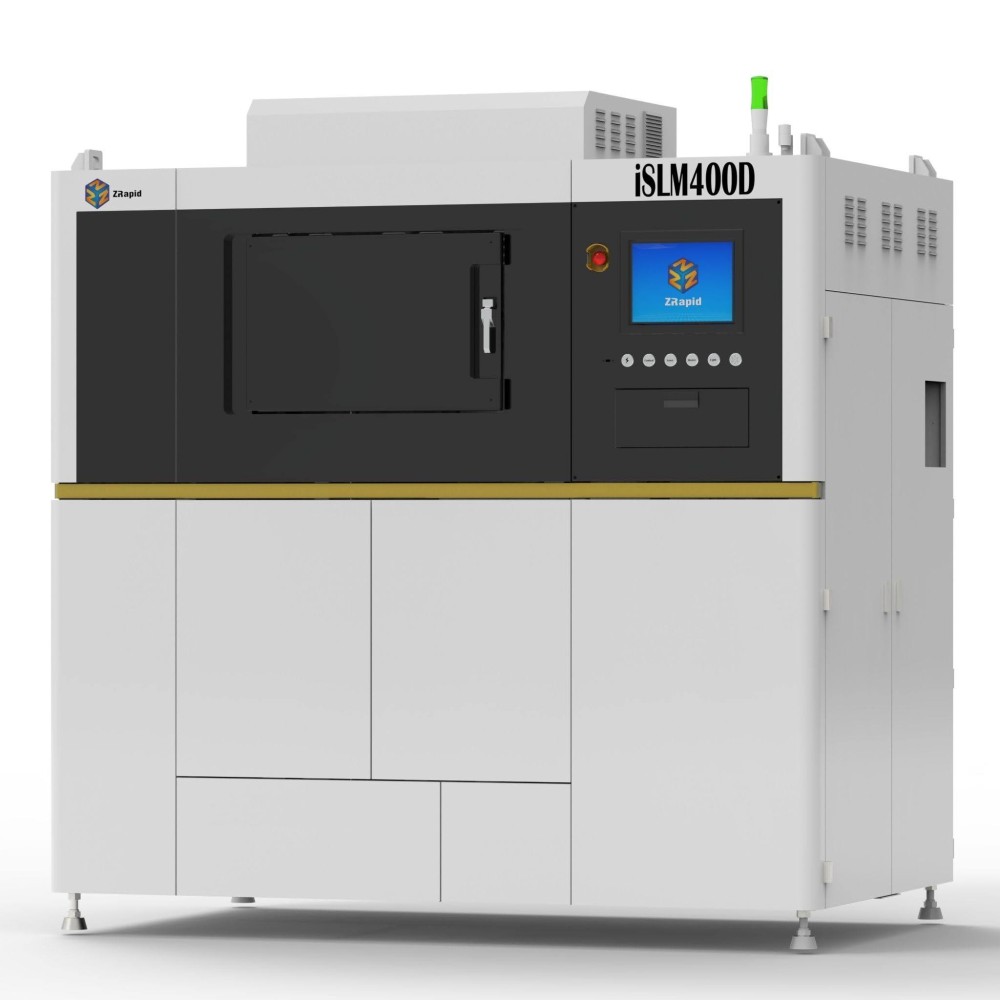
In the context of HLH Prototypes, the presence of multiple ZRapid iSLM400 systems reflects broader industry adoption of the platform within industrial production environments. The focus in such deployments is typically on system integration into existing manufacturing setups, including installation coordination and post-installation technical support, rather than involvement in production process design or internal workflow structuring.
This reflects the standard structure of industrial equipment deployment in the metal additive manufacturing sector, where manufacturers, distributors, and service bureaus each operate in distinct and clearly defined roles within the production ecosystem.
Industry Context: Metal AM in Service Bureau Evolution
The role of metal additive manufacturing in service bureaus has changed significantly over the past decade. It is increasingly treated as a production resource rather than a prototyping tool. This shift is driven by demand for shorter lead times, more complex geometries, and small batch production that does not justify traditional tooling.
As a result, service bureaus are moving toward distributed machine environments rather than relying on a limited number of high-capacity systems. This allows for better utilisation balancing, reduced downtime risk, and more flexible job scheduling.
In metal AM specifically, this has led to a preference for multiple industrial systems operating in parallel. The goal is not to maximise output from a single machine, but to maintain stable throughput across a cluster of machines. This approach aligns more closely with how service bureaus operate under mixed and unpredictable demand conditions.
HLH’s use of multiple SLM systems reflects this broader trend. It represents a shift toward capacity architecture rather than isolated equipment upgrades.
Conclusion: Capacity Architecture Over Machine Selection
The expansion of SLM capacity at HLH Prototypes illustrates how metal additive manufacturing is being used in production environments today. The focus is no longer limited to machine capability, but to how that capability fits into a broader manufacturing system.
By distributing workload across multiple ZRapid SLM systems, HLH improves scheduling flexibility, reduces production bottlenecks, and increases resilience in continuous operation. The benefit is not only higher capacity, but more stable and predictable output across the full manufacturing chain.
In this context, ZRapid systems function as part of a capacity layer within a larger service bureau infrastructure. The value comes from how they are integrated into production scaling strategies, rather than from isolated machine performance metrics.
Contact us, and our expert team will help you find the best solution tailored to your needs!
Email: info@anima.eu
Contact number: +30 210 77 76 822